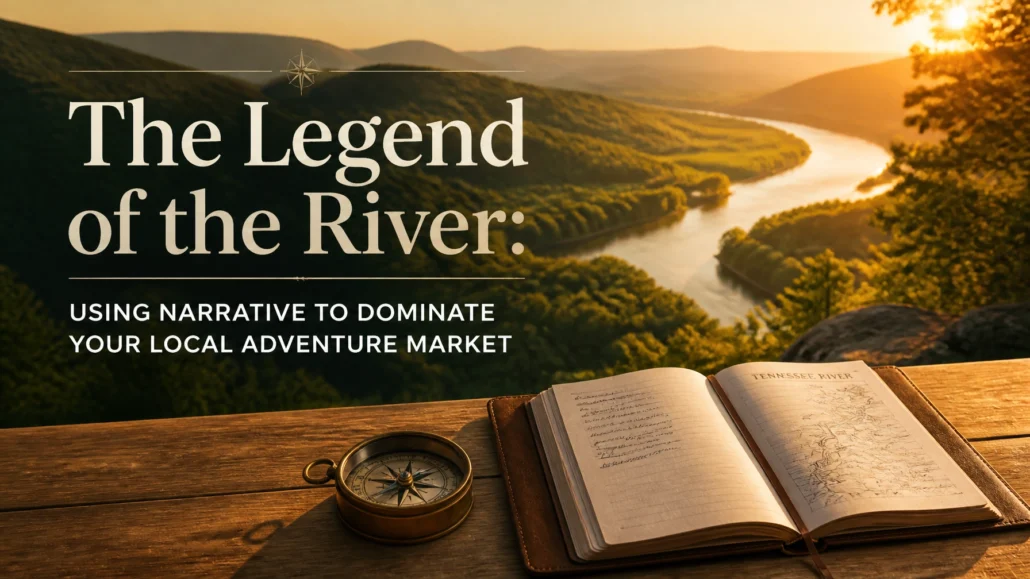
You’ve seen the photos. The perfectly timed shot of a kayak cutting through a Class IV rapid, the high-res drone footage of a mountain bike trail in the Smokies, the sunset over the Tennessee River that looks like it belongs on a postcard.
In the outdoor rec industry, we love our "pretty pictures." And look, I get it: it’s a visual world. But if you’re relying on stock-level imagery and a list of "top-tier gear" to sell your adventures, you’re leaving money on the riverbank.
Why? Because your competitors have cameras too. They have the same rivers, the same trails, and probably the same brand of rafts. If you want to stop competing on price and start dominating your local market, you HAVE to stop selling the activity and start selling the Legend.
Your Story is Your Edge
Most adventure businesses treat their brand like a utility. "We offer rafting. We have 10 boats. We are open from 9 to 5."
That’s not a brand; that’s a phone book listing.
In my coaching, I work with relentless entrepreneurs who understand that people don’t buy a trip: they buy a transformation. They buy the story they’re going to tell their friends at the bar on Monday morning. They buy the feeling of conquering a fear or finally unplugging from a soul-crushing 60-hour work week.
When I talk about building a powerful brand narrative, I’m talking about taking that raw East Tennessee energy and bottling it. It’s about moving beyond "features" and into "feelings."
Think about it: Are you a guy who rents kayaks, or are you the guide who helps families reconnect without a screen in sight? Are you a gym owner, or are you the person who helps a 40-year-old CEO regain the physical stamina to hike the Appalachian Trail with his kids?

Being the Guide, Not the Hero
Here is where most business owners get it wrong. They make the story about themselves. They talk about their 20 years of experience, their certifications, and their shiny new equipment.
Don't get me wrong: authority matters. But in a truly dominant narrative, your customer is the hero. You? You are the Guide.
Think about the best stories you know. The hero is usually someone facing a challenge: they’re nervous, they’re out of their element, or they’re looking for something more. Then, they meet the Guide. The Guide has the map, the wisdom, and the "been there, done that" swagger to show them the way.
As a best-selling author who co-authored Flip The Script with Chris Voss, I’ve spent a lot of time dissecting how empathy and relationship-building are the keys to any successful negotiation: and business is one long negotiation for trust. When you use empathy to understand your guest's "internal problem" (like the fear of not being "outdoorsy" enough), and you pair it with your authority as a guide, you become irreplaceable.
You aren't just selling a ticket; you're offering a bridge to their best self.
GMB: Your Digital Campfire
In the local adventure market, your Google Business Profile (GMB) is one of the easiest places to practice better storytelling without overthinking it.
Stop thinking of GMB as just a place for your address and phone number. This is your digital campfire. It’s where people get a feel for what doing business with you is actually like. And if you use it well, it can help you stand out in a market where a lot of companies are posting the same kind of photo with the same kind of caption.
So let me make this practical. You do not need to become some master copywriter overnight. You just need a simple framework you can use on your next post.
A Simple Storytelling Framework for Your Next GMB Post
One of the easiest frameworks is Before / After / Bridge.
- Before: What was the customer feeling, facing, or wanting before the experience?
- After: What changed?
- Bridge: What helped them get there?
That’s it. Simple. Clean. Useful.
For an outdoor business, it might look like this:
- Before: "This family wanted to get outside together, but the kids were glued to screens and Dad wasn’t sure everybody would enjoy the trip."
- After: "By the end of the day, they were laughing, soaked, and already asking when they could come back."
- Bridge: "A beginner-friendly route, the right guide, and a little encouragement made the difference."
You can also use a Hero’s Journey lens if that clicks better for you:
- The challenge: "We’ve never done this before."
- The guide: "Here’s how we help you feel ready."
- The win: "Now you’ve got a story you’ll be talking about all week."
See the difference? You’re not just posting a photo. You’re giving the photo a heartbeat.
Commodity Caption vs Legendary Caption
Let’s say you post a photo of a raft coming through a rapid.
Commodity caption:
"Another great rafting trip on the river today. Book now for weekend availability."
That’s fine. But it sounds like everybody else.
Legendary caption:
"This crew showed up a little nervous this morning—especially the guy in the back who kept asking how wet he was about to get. Two hours later, they were cheering through every rapid and arguing over who got the biggest splash. That’s what I love about days on the river: people show up looking for something fun and leave with a story they’ll tell all summer."
Same photo. Different impact.
One is just information. The other creates connection.
How to Find the Hidden Stories in Daily Operations
Now you may be thinking, "That sounds great, but my day doesn’t feel that interesting." I get it. When you’re in the grind, everything starts to look normal. But the hidden stories are usually sitting right in front of you.
Here’s where to look:
First-timer nerves
What were people worried about before they started? What almost kept them from showing up?Small turning points
When did the mood change? Was it the first laugh, the first successful cast, the first rapid, the first moment someone said, "Okay, this is actually awesome"?Unexpected wins
Did a quiet kid come alive? Did a nervous guest become the loudest one in the group? Did a family actually put their phones down for three straight hours?Behind-the-scenes effort
What did your team do that made the experience smoother, safer, or more memorable? The guest may only see the trip. You see the preparation, leadership, and care behind it.Repeat phrases
Pay attention to what customers keep saying:- "I didn’t think I could do that."
- "That was way more fun than I expected."
- "We needed this."
Those are story gold. Write them down.
If you want to strut your stuff and actually win the local SEO game in Knoxville or anywhere else, start using your GMB like a living journal of real moments:
- Don't just post the gear or scenery. Ask yourself, "What was changing in this moment?"
- Use short story captions. A few sentences with a clear before, after, and bridge will go a long way.
- Respond to reviews like a human. Bring the moment back to life instead of defaulting to "Thanks for coming."
- Share behind-the-scenes updates. Show the work it takes to keep the gear ready, the trips smooth, and the experience strong.
When you consistently tell real stories, you stop sounding like a commodity and start sounding like the kind of business people remember.

Building the Stamina for the Long Game
You can’t lead a legendary business if you’re running on fumes.
I see it all the time: outdoor entrepreneurs who are so busy running the business that they let their own health slide. You’re "sweating it out" in the office, but you haven't touched a kettlebell in months.
If you want to maintain the mental clarity to craft a winning brand and the physical presence to lead your team, you have to prioritize your body. Your business is an engine, but you are the fuel.
Peak performance in the adventure industry requires a level of physical resilience that matches the terrain you work in. Whether it’s a quick rowing session before the sun comes up or a focused strength routine, keeping your body sharp ensures you have the "swagger" needed to lead with confidence. When you look like you can handle the mountain, people trust you to lead them up it.

The Market Dominance Blueprint (MDB)
So, how do you take all this: the narrative, the local presence, the physical stamina: and turn it into a scalable machine?
That’s where The Market Dominance Blueprint (MDB) comes in.
Winning your market isn't about one "lucky" viral post. It’s about a systematic approach to how you present your business and your brand. The MDB is my 7-step framework designed to help you stop reacting to the market and start commanding it.
We look at how your narrative connects with your audience, how your local presence (GMB) is performing, and whether your internal leadership is strong enough to support the growth you want. It’s about building a business that is as rugged and reliable as the gear you sell.
Kick Into Gear
Before you overcomplicate this, do one simple thing: use the Before / After / Bridge framework on your very next GMB post.
The river is moving, and the market doesn't wait for the "perfect" time to start. So don’t just post and hope. Be intentional.
Here is your next move:
- Pick one recent photo: Choose a real moment from a trip, a lesson, a handoff, or a customer win.
- Write the story: In one short caption, explain what was happening before, what changed, and what helped make that change happen.
- Look for hidden stories this week: Pay attention to nerves, breakthroughs, funny moments, and customer quotes. That’s where the good stuff lives.
If you want a clearer look at how your message, leadership, and local presence are showing up, check out The Market Dominance Blueprint (MDB).
Don’t just post another photo. Give people something they can feel, remember, and talk about. That’s how you build momentum that lasts.