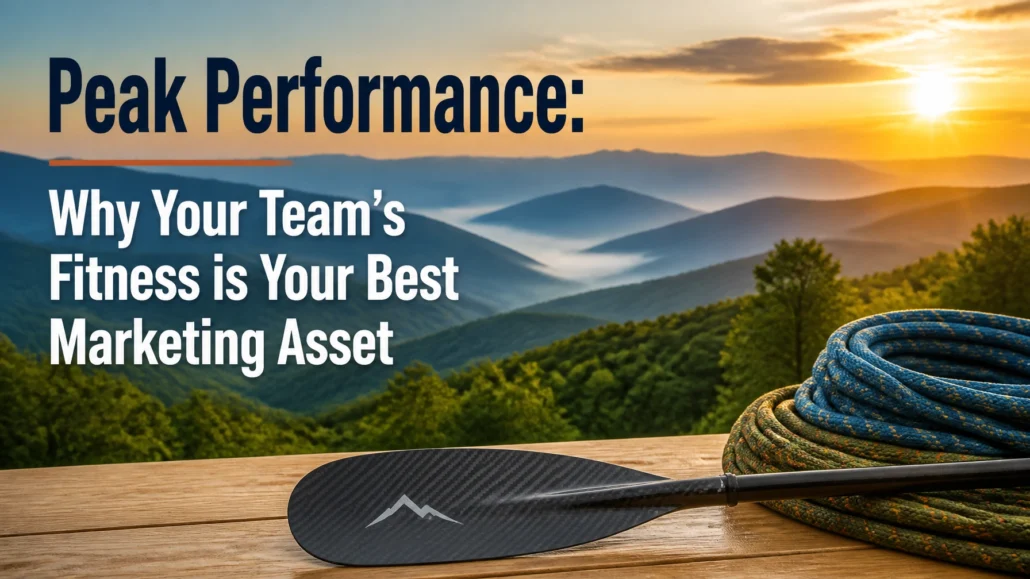
You’re in the business of selling adventure. Whether you’re running whitewater rafting trips down the Ocoee, guiding climbers up the crags of East Tennessee, or managing a fleet of mountain bikes, your product isn’t just a "trip." It’s an experience. It’s a feeling.
But here’s the cold, hard truth that most adventure business owners ignore: Your team is the visual representation of that experience.
If your guides are huffing and puffing more than the clients, or if you’ve let your own health slide into the "I'm too busy for the gym" abyss, you aren't just losing your breath, you’re increasing risk. In the outdoor recreation world, fitness isn't a hobby. It’s part of operational readiness.
I’m not just talking about looking good in a branded polo. I’m talking about the raw, undeniable link between physical stamina, safety, decision-making, and long-term business health. Let's get into the real "why" behind team fitness, because this isn’t about vanity. It’s about keeping your people sharp, your clients protected, and your business running strong.
The Stamina Factor: Reliability is Profitable
Think about the last time a guide called out "sick" or "exhausted" right before a fully booked Saturday. It’s a nightmare. You’re scrambling to find a replacement, or worse, you’re turning away paying customers.
When you prioritize the physical health of your crew, and yourself, you are essentially buying insurance for your schedule. A fit team is a resilient team. They recover faster, they handle the Tennessee heat better, and they stay sharp when the day gets long.
In my coaching, I don't treat your business and your body as separate entities. They are completely intertwined. If your body is failing, your leadership will eventually follow suit. You can’t make high-level strategic decisions when you’re operating on fumes and caffeine. You need the mental clarity that only comes from a body that’s primed for performance.
Building Unshakeable Trust (and Real-World Safety)
Whether we like it or not, people judge a book by its cover, especially when that book is about to lead them through a Class IV rapid or up a mountain.
When a client walks into your shop and sees a team that looks capable, energetic, and physically prepared, their anxiety drops. Trust is built before you even say "hello." But this goes way deeper than appearance. This is about whether your team can stay calm, think clearly, and physically respond when the tough stuff shows up.
Think about it. What happens when a raft flips and a guide has to swim hard, recover gear, and help a tired guest back to shore? What about when a mountain bike guide has to hike a damaged bike out while keeping the rest of the group moving? Or when a climbing instructor has to stay dialed in on belay after six straight hours in the Tennessee heat? Fitness directly affects how safely your team handles those moments.
And yes, it can hit your insurance costs too. More fatigue usually means more mistakes. More mistakes can mean more incident reports, more workers' comp claims, and more red flags during policy reviews or renewals. I’m not saying a few trail runs magically lower premiums overnight, but I am saying this: when your team is conditioned, alert, and less injury-prone, you give yourself a better shot at fewer preventable incidents. Fewer preventable incidents is exactly the kind of thing insurers, underwriters, and your bottom line care about.
As a best-selling author who co-wrote Flip The Script with Chris Voss, I know perception matters. In the adventure world, though, your team’s physical readiness is more than perception. It’s proof. It tells the client, "We’ve got this, and we’ve got you."
The ROI of Sweat: Safety, Insurance, and Better Client Experiences
Let’s talk about the numbers. What’s the ROI of a team that can out-hike the clients without breaking a sweat? A whole lot more than better photos and good vibes.
- Lower Incident Rates: Fatigue is one of the biggest drivers of sloppy decisions. Slower reactions at the take-out, poor footing on a carry, weak posture when loading gear, or mental fog during a safety briefing can all create problems. A fit guide has more physical and mental "buffer" late in the day.
- Fewer Preventable Injuries: Better conditioning can reduce soft-tissue strains, overuse injuries, and exhaustion-related mistakes. That matters when your crew is lifting rafts, carrying packs, spotting climbers, or grinding through back-to-back summer trips.
- Healthier Insurance Conversations: If you can show lower incident frequency, fewer workers' comp claims, and stronger safety routines, you're in a better position when talking with carriers and brokers. Insurance pricing depends on a lot of factors, but a healthier, more prepared team supports a stronger risk profile.
- Better Storytelling: A guide who isn't struggling to breathe has the energy to actually talk to the clients. They can share the local history of the Smokies, tell jokes, and build the kind of rapport that leads to a 5-star Google Business Profile (GMB) review.
- The "Hero" Moment: When a client gets stuck or tired, a fit guide can step in and save the day physically. That moment sticks. It gets talked about in reviews, referrals, and campfire conversations long after the trip is over.

You Can't Lead from the Couch
I see it all the time: entrepreneurs who are "relentless" in their business but "relaxed" in their health. You’re grinding 80 hours a week, building your GMB presence, and obsessing over your funnel, but you haven't seen the inside of a gym in months.
Stop it.
You are the engine of your business. If the engine is gunked up, the car doesn't win the race. I push my clients to understand that their physical discipline is a direct reflection of their business discipline. If you can’t master the 30 minutes you spend with a kettlebell, how can I trust you to master a complex marketing system or a team of twenty guides?
Success isn't just about the bank account; it's about being healthy enough to enjoy the life you’re building. What’s the point of scaling your outdoor rec empire to seven figures if you can’t even hike your own trails?

How to Integrate Fitness into Your Business Culture
You don't need to turn your gear shop into a CrossFit box, and you definitely don’t need a huge budget. You just need consistency and a reason your team actually buys into. Here’s how you start:
- Create low-cost group challenges: Weekly trail runs, stair climbs, ruck walks, or bodyweight circuits before opening can kick things into gear without costing much. Keep it simple. Thirty minutes. Same day every week.
- Build friendly staff competitions: Track attendance, improvement, or consistency instead of just raw performance. Maybe it’s "most workouts completed this month" or "best improvement on a pack-carry test." A little swagger and accountability go a long way.
- Use your environment as the gym: You’re in outdoor rec. Use that. Hike local trails, do on-river carry drills, practice bike hike-outs, or run mock rescue efforts as conditioning sessions. That way your team trains for the job, not just around it.
And if you really want this to stick, tie fitness to readiness, not appearance. This isn’t about six-packs. It’s about whether your people can perform when the day gets long and the pressure turns up.
How to Measure "Team Stamina"
If you can’t measure it, you’ll end up guessing. And guessing is how owners miss problems until peak season punches them in the mouth. Here are a few practical ways to track team stamina without getting fancy:
- Recovery time after exertion: After a hike, carry, or interval effort, how long does it take team members to get their breathing under control and communicate clearly? Faster recovery usually signals better conditioning.
- End-of-day performance: Are safety briefings still sharp on the last trip of the day? Is gear loading still clean? Are guides still engaged with guests at hour six or seven? Energy fade tells a story.
- Job-specific benchmark tests: Time a standard uphill carry, loaded hike, paddle segment, bike push, or rescue drill. Re-test monthly. You’re not looking for perfection. You’re looking for trends.
- Incident and near-miss patterns: Are mistakes happening more often late in shifts, during hot weather, or after consecutive long days? That’s useful data. Fatigue leaves clues.
- Self-reported readiness: Ask your team to rate energy, soreness, and readiness at the start of the week and after busy weekends. It sounds simple, but patterns show up fast when people are honest.
That’s how you build a crystal ball. Not by hoping your team is "in shape," but by paying attention to the signals that show whether they can actually sustain performance.
The Market Dominance Blueprint (MDB)
Scaling an adventure business requires more than just grit; it requires a system. My Market Dominance Blueprint (MDB) helps you look at the full picture: your operations, your brand, your leadership, and the habits that keep your team strong enough to perform when it counts.
When those pieces are aligned, you don't just compete: you operate at a higher level. You become the go-to name in Knoxville and beyond because your business runs safer, sharper, and with more consistency.
Are You Ready to Level Up?
You’ve got the passion. You’ve got the gear. Now ask yourself this: does your team have the stamina to stay safe, sharp, and dependable when the season gets brutal?
The outdoor recreation market is getting crowded. The businesses that separate themselves won’t just have the best branding or the slickest website. They’ll have teams that can perform under pressure, protect the client experience, and keep showing up strong day after day.
So where do you stand right now? Are your people conditioned for the real demands of the job? Are you measuring stamina or just assuming it’s there? Are fatigue-related mistakes quietly costing you more than you realize?
If this article got you thinking, start with one move this week. Set one team challenge. Track one stamina metric. Have one honest conversation about readiness.
Want more practical ways to strengthen your business, sharpen your leadership, and build a team that can actually sustain success? Download The Market Dominance Blueprint (MDB).
Let’s get to work.