
Let’s be real for a second: if you’re using AI just to write captions or answer basic customer emails, you’re essentially using a Ferrari to drive to the mailbox.
Look, I get it. The chatbot craze was the "gateway drug" for entrepreneurs entering the world of artificial intelligence. It was accessible, it was flashy, and it saved us time. But if you want to scale: if you want to move from "keeping your head above water" to actually predicting where the next wave is coming from: you have to look beyond the chat window.
We are moving into an era where the most successful leaders aren't just using AI to talk; they’re using it to think. Specifically, they’re using AI-driven analytics to build a crystal ball for their business.
I’m talking about moving from reactive mode to proactive mastery. In my coaching, I constantly see driven business owners who are brilliant at what they do, but they’re exhausted because they’re always playing defense. They wait for a sales dip to fix their marketing. They wait for a client to leave before they ask what went wrong.
What if I told you that by April 2026, the tech exists for you to see those dips coming weeks in advance?
The Difference Between Talking to AI and Listening to Data
Most people treat AI like a high-end intern. You give it a task, it gives you an output. That’s great for efficiency, but it doesn't change the trajectory of your company.
AI-driven analytics, on the other hand, is like having a co-founder who has memorized every single data point your business has ever produced. It doesn't sleep, it doesn't have "off days," and it’s obsessed with finding patterns that you: as a busy human being: are simply too close to the fire to see.
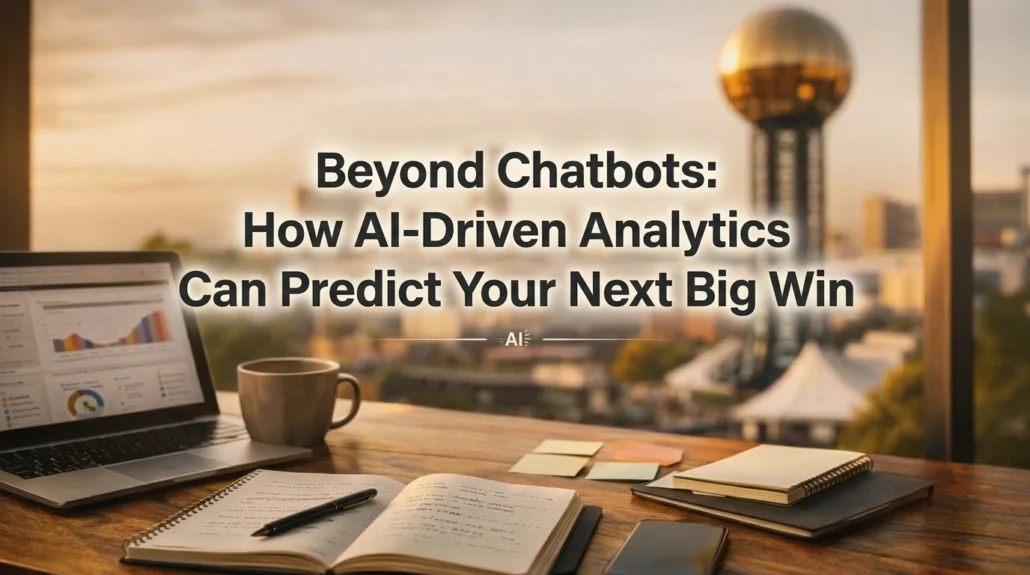
When we talk about "predicting your next big win," we’re talking about Predictive Analytics. While a chatbot is a bridge between you and a customer, predictive analytics is a bridge between your past performance and your future success.

1. Anomaly Detection: Finding the Needle Before It Pricks You
In the world of business coaching, I see a lot of "mystery losses." A project goes over budget, a marketing campaign flops, or a key employee suddenly burns out. Usually, there were signs: tiny, microscopic anomalies in the data that went unnoticed.
AI-driven analytics uses anomaly detection to establish a "baseline" for your business. It knows what a "normal" Tuesday looks like for your GMB (Google Business Profile) engagement. It knows what a "normal" conversion rate looks like for your high-ticket offers.
When something deviates from that baseline: even by a fraction: the AI flags it.
- The Threat: Detecting a slow-down in repeat customer behavior before they actually churn.
- The Opportunity: Identifying a sudden surge in interest from a specific zip code in Knoxville before you’ve even spent a dime on local ads there.
This allows you to act on insights within hours, not weeks. That timing is the difference between a minor course correction and a total wreck.
2. Churn Prediction: Saving Relationships with Empathy and Data
You’ve heard me talk about my book, "Flip The Script," co-written with Chris Voss. A massive part of building a resilient business is empathy. But how do you apply empathy at scale?
You use AI to tell you who needs it most.
Predictive models can analyze customer behavior: how often they log in, their tone in support tickets, the speed at which they pay invoices: to give you a "churn score." If the AI tells me that a long-term client is 80% likely to leave in the next 30 days based on their shifting engagement patterns, I’m not going to send them an automated "We miss you" email.
I’m going to pick up the phone. I’m going to use that empathy-led leadership to have a real conversation. The AI gave me the lead time; my humanity closed the gap. That is the synergy that wins in 2026.

3. Demand Forecasting: Stop Guessing, Start Knowing
Whether you’re selling physical products or high-level coaching services, "guessing" your inventory or your capacity is a recipe for burnout.
If you're an entrepreneur in Knoxville looking to dominate the local market, you need to know when the "busy season" is actually coming: not just when it usually comes. AI-driven analytics takes into account global market trends, local economic shifts, and even seasonal weather patterns to tell you exactly when to ramp up your marketing spend and when to lean back and focus on internal culture.
How to Start Without a Data Science Degree
I know what you’re thinking: "JT, I’m a business owner, not a coder. I don't have the time to build these models."
Here’s the secret: You don't HAVE to.
By 2026, the democratization of AI means that about 40% of analytics queries are now happening through natural language. You don't need to write SQL; you just need to know what questions to ask. Tools like Tableau, PowerBI, and even specialized AI layers for your CRM allow you to ask, "Which of my lead sources is most likely to produce a high-value client in Q3?" and get a visualized answer in seconds.
But here is the catch: AI is only as good as the data you give it.
If your "data" is scattered across sticky notes, three different spreadsheets, and a half-functional CRM, no AI in the world can help you. Your first step toward predictive wins is Data Hygiene. Start centralizing your information. Every interaction, every sale, and every GMB review needs to be tracked.

The Swagger of a Data-Informed Leader
There is a specific kind of confidence that comes from knowing the numbers have your back. It’s the same feeling you get when you’ve hit the gym consistently for six months: you move differently because you know what you’re capable of.
When your business, your brand, and your physical health are all firing on the same cylinder, you have the mental clarity to look at an AI-generated forecast and make a gut-level decision that others are too afraid to make.
I’ve always said that a strong business and a healthy body go hand-in-hand. Why? Because the mental stamina required to parse through high-level insights and execute on them is massive. If you’re sluggish, you’ll ignore the data. If you’re sharp, you’ll exploit it.
Your Next Move
Are you still just "chatting" with AI, or are you letting it help you lead?
Don't wait for the end of the quarter to see how you did. Start looking for tools that offer predictive insights. Start treating your data like the valuable asset it is.
Ask yourself these three questions today:
- What is one "mystery" in my business that I wish I could have seen coming?
- Is my data centralized enough for an AI to actually read it?
- Am I physically and mentally sharp enough to act when the AI flags a "big win" opportunity?
Success in 2026 isn't about who has the best chatbot. It’s about who has the best foresight. I’m here to make sure you have both.

More Insights & Related Reading:
- Why Leadership Development Coaching is the Secret Weapon for Scaling Your Business
- Building Your Brand Narrative in the Scruffy City: A Knoxville Guide
- The Ultimate ROI: Why Your Fitness is the Engine of Your Success
Ready to stop playing defense and start predicting your wins? Reach out to me and let’s talk about how to integrate these strategies into your specific framework for growth. Let's get to work.