
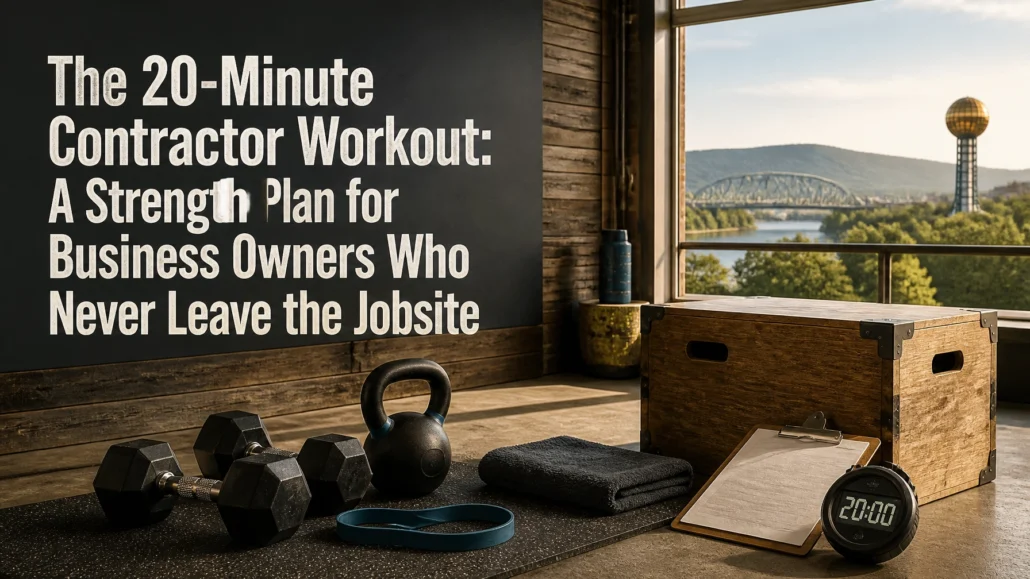
You do not need a two-hour gym session to build a stronger body.
You need a plan you can actually repeat.
If you own a roofing company, landscaping business, remodeling company, HVAC operation, plumbing business, or another home service company, your schedule is probably packed from sunrise to sundown. You are quoting jobs, answering calls, solving customer problems, checking crews, and sometimes jumping back into the work yourself.
So where does fitness fit?
Right in the middle of the real world.
This 20-minute workout is designed for busy contractors and service business owners who need practical strength training without complicated equipment or a long commute to the gym. It is not a magic formula. It is a simple system for building consistency when your calendar is already crowded.
That is the real game in fitness for entrepreneurs: remove friction, do the work, and keep moving.
The 20-Minute Contractor Workout at a Glance
You will need:
- A pair of dumbbells, kettlebell, or loaded backpack
- A sturdy step, bench, or elevated surface
- A clear area where you can move safely
- A timer
The session is split into four parts:
- 3 minutes: Warm-up
- 12 minutes: Full-body strength circuit
- 3 minutes: Optional conditioning
- 2 minutes: Cool-down and breathing
The workout should feel focused, not frantic. You are training for strength and durability, not auditioning for a highlight reel.

1. Warm Up for Three Minutes
Do not skip the warm-up because you are short on time. Three intentional minutes are enough to get your body moving through the patterns you will use in the workout.
Perform each movement for approximately 30–45 seconds:
March in Place
Start easy, then gradually increase your pace. Let your arms move naturally.
Bodyweight Squat
Stand with your feet about shoulder-width apart. Sit your hips down and back, then stand tall. Use a shorter range of motion if your hips, knees, or ankles feel restricted.
Hip Hinge
Place your hands on your hips. Soften your knees and push your hips behind you while keeping your back neutral. Stand by driving your hips forward.
This prepares you for the deadlift pattern.
Arm Circles and Shoulder Rolls
Use controlled circles. The goal is to loosen up, not create momentum.
Your warm-up should leave you feeling more prepared, not tired. Smooth, pain-free movement matters more than speed.
2. Complete the 12-Minute Strength Circuit
You will perform four exercises using a 40-seconds-work, 20-seconds-rest format.
Complete three rounds:
- 40 seconds of work
- 20 seconds to rest and transition
- Four exercises per round
- Three total rounds
Choose a weight that allows you to maintain solid technique from the first round through the last. If your form falls apart before the timer ends, reduce the load or switch to the easier modification.
Exercise 1: Goblet Squat
Hold one dumbbell or kettlebell at chest height.
- Keep your chest tall.
- Brace your midsection.
- Lower under control.
- Drive through your feet to stand.
No equipment? Use a bodyweight squat.
Need a modification? Squat to a bench or sturdy box. Lightly touch the surface, then stand.
The goal is controlled lower-body strength: not dropping into the deepest squat possible.
Exercise 2: Dumbbell Romanian Deadlift
Hold dumbbells in front of your thighs.
- Keep a slight bend in your knees.
- Push your hips backward.
- Keep the weights close to your legs.
- Stop when you feel tension in the backs of your legs.
- Stand tall by squeezing your glutes.
Do not turn this into a squat. The hips should travel backward while your spine stays neutral.
No dumbbells? Use a kettlebell, loaded backpack, or bodyweight hip hinge.
If you are unfamiliar with the movement, practice the hinge without weight first. The tough stuff only works when you control the basics.
Exercise 3: Push-Up or Incline Push-Up
Choose the version that lets you maintain a straight line from your shoulders through your hips.
- Keep your hands slightly wider than shoulder width.
- Lower with control.
- Press the floor away.
- Keep your neck relaxed.
Modification options:
- Hands on a sturdy bench or countertop
- Knees on the floor
- Dumbbell floor press
Do not use a shaky, unstable surface. A worksite may have plenty of equipment around, but not everything is designed to support your body weight.
Exercise 4: Supported One-Arm Row
Use one dumbbell and support your free hand on a stable bench or work surface.
- Hinge slightly at the hips.
- Pull the weight toward your ribs.
- Keep your shoulder away from your ear.
- Lower slowly.
- Switch sides halfway through the interval.
No dumbbell? Use a resistance band anchored to a secure point.
If you only have bodyweight, perform a prone “W” raise on the floor. Lie face down, gently lift your arms into a W shape, and squeeze your shoulder blades together without shrugging.
This circuit covers the major movement patterns without asking you to perform complicated exercises while fatigued.
3. Add a Three-Minute Conditioning Option
The conditioning block is optional.
If you are new to training, recovering from a demanding workweek, or already feeling worn down, skip it and use the extra time for easy walking and breathing.
If you are ready, choose one option:
Option A: Brisk March
Perform:
- 40 seconds of brisk marching
- 20 seconds of easy movement
- Repeat three times
Drive your arms naturally and keep the pace controlled.
Option B: Low Step-Ups
Use a low, stable step.
- Step up with control.
- Stand tall.
- Step down carefully.
- Alternate your lead leg.
Avoid this option if the surface is unstable or the jobsite is cluttered.
Option C: Stationary Bike or Rower
If you have access to equipment, perform three moderate intervals of 40 seconds with 20 seconds of easy movement between efforts.
You do not need to finish breathless. The purpose is to add a short conditioning challenge without turning the entire workout into a grind.

4. Use Two Minutes to Recover
Finish with two minutes of easy movement and controlled breathing.
- Walk slowly for one minute.
- Take relaxed breaths.
- Gently stretch your chest, hips, calves, or thighs for the remaining minute.
- Let your heart rate come down gradually.
This is also your transition point. You just went from running your business to training your body. Give yourself a moment before jumping straight back into calls, estimates, or crew issues.
How Often Should You Do This Workout?
Start with two sessions per week on nonconsecutive days.
For example:
- Tuesday: Workout
- Friday: Workout
After three or four weeks, you can move to three sessions if your recovery is good:
- Monday: Workout
- Wednesday: Workout
- Saturday or Sunday: Workout
If weekends are your busiest time, use Monday, Wednesday, and Friday instead. The best plan is the one that matches your actual operating schedule.
Consistency beats a heroic workout you only complete once every six weeks.
That is one of the central ideas behind executive health coaching: your training plan must fit your responsibilities instead of pretending your responsibilities do not exist.
How to Progress Without Overcomplicating It
Do not increase weight, speed, volume, and difficulty all at once. Pick one variable and progress gradually.
Use this simple four-week approach:
- Week one: Learn the movements with light or moderate resistance.
- Week two: Maintain the same exercises and improve control.
- Week three: Add a small amount of weight if your form remains strong.
- Week four: Increase the challenge slightly or make the conditioning intervals more purposeful.
You can also progress by:
- Adding two or three seconds of control to the lowering phase
- Using a slightly heavier weight
- Moving from incline push-ups toward floor push-ups
- Increasing your step height modestly
- Reducing unnecessary transition time
A good rule: finish each set feeling like you could complete a few more quality repetitions if necessary. You should be challenged, but you should not be chasing failure during every round.

Safety Modifications for Busy Business Owners
Your body is not a machine you can ignore until something breaks. Use common sense and make the workout fit your current ability.
- Stop any movement that causes sharp or unusual pain.
- Reduce the range of motion if full depth feels uncomfortable.
- Use incline push-ups instead of floor push-ups.
- Replace step-ups with marching if balance or joint comfort is an issue.
- Use bodyweight instead of external weight while learning technique.
- Choose stable, dry surfaces.
- Keep tools, cords, materials, and other jobsite hazards out of your training area.
- Do not train at maximum effort when you are severely sleep-deprived, sick, or unusually fatigued.
- If you have an injury, medical condition, or concern about starting a new exercise routine, speak with an appropriately qualified healthcare professional first.
This is general fitness education, not individualized medical advice.
Why This Matters for Service Business Growth
Your company does not grow because you bought a kettlebell.
It grows when you make better decisions, communicate clearly, lead consistently, and have enough capacity to handle the demands of ownership. Training can become one practical way to protect time for yourself while building a stronger operating rhythm.
The connection between fitness and service business growth is not about promising that exercise will solve every business problem. It is about recognizing that the owner is part of the operating system.
If you are always exhausted, constantly reactive, and physically run down, your business decisions can start to reflect that pressure. A short workout will not replace sound pricing, hiring, marketing, or systems. But it can help you create a repeatable standard for taking care of the person responsible for all of them.
I believe relentless business owners deserve more than advice to “work harder.” You need useful systems that help you think clearly, lead better, and stay in the game.
Twenty minutes is a small commitment. That is why it works so well as a starting point.
Make the Workout Easy to Repeat
Put the dumbbells where you can see them.
Schedule the workout before the day gets chaotic. Keep a timer ready. Use the same four movements for at least a few weeks instead of constantly searching for a new routine.
Could you complete this workout before your first appointment? During a lunch break? Immediately after closing out the day?
Pick two realistic time slots and put them on the calendar.
Then show up: even if you need to use the modified version.
For more practical support connecting your health, leadership, and business direction, explore my services, review my free resources, and look for The Market Dominance Blueprint (MDB). You can also contact me if you want help building a more sustainable operating rhythm.
More Insights
- Read my marketing systems resources for ways to reduce avoidable business friction.
- Visit the Coach JT articles page for more business, brand, and body insights.
- See what scaling contractors sacrifice first when growth starts demanding more than expected.
- For additional background on time-efficient strength training, review this 20-minute strength workout guide for busy professionals.
Will you protect 20 minutes this week?
Will you train before your schedule takes over?
And what would change in your business if taking care of yourself became part of the plan( not the thing you keep pushing to next month?)