
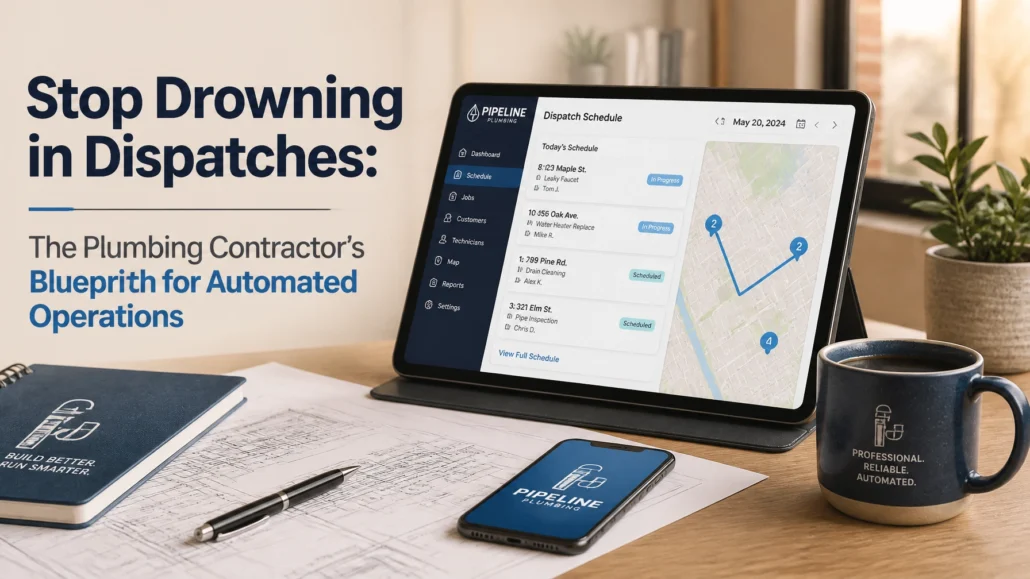
If you are running a plumbing or electrical contracting business, you already know the sound. It’s 7:30 AM, your phone is vibrating off the nightstand, two technicians are standing in your office doorway waiting for their first job sheet, and a frantic customer just called because water is backing up into their basement. You grab a dry-erase marker, scribble a frantic note on the whiteboard, shout an address across the shop, and hope for the best.
Sound familiar? You aren't managing a growing enterprise; you’re playing an exhausting game of high-stakes Tetris.
When I talk with contractors during my home service business coaching sessions, this is the exact moment they hit the wall. They are working sixty hours a week, sweating it out in the trenches, and wondering why adding another truck only seems to double their stress instead of their profits. They want service business growth, but their operations are anchored to a clipboard and a ringing landline.
If you are ready to stop reacting and start scaling a service business like a true executive, you need to eliminate the dispatch bottleneck. Let's look at how you can automate your operations, reclaim your sanity, and build a machine that runs smoothly without you micromanaging every single mile.
The True Cost of Manual Dispatching
Let’s tackle the tough stuff right out of the gate. Manual dispatching is a silent profit killer. Whether you are scribbling jobs on a whiteboard, juggling text messages while driving between job sites, or relying on messy spreadsheets, every minute spent coordinating logistics manually is a minute stolen from revenue-generating work.
When your dispatch relies on memory and panic, several things happen:
- Wasted Windshield Time: Techs drive past each other across town because routes weren't optimized by location.
- Dropped Balls: Inquiries from your Google Business Profile or website sit unanswered while your dispatcher handles an angry customer on line two.
- Billing Delays: Paper invoices sit in the cup holder of a service van for four days before they make it back to the office, crushing your cash flow.
As a best-selling author who co-wrote Flip The Script alongside Chris Voss, I learned a fundamental truth about human interaction and systems: empathy and structure go hand-in-hand. Your customers want clarity and speed, and your team wants clear direction. When you replace chaos with automated workflows, you build trust with your clients and operational peace for your crew.

Step 1: Centralize Job Intake and Digital Work Orders
The first step toward scaling your service business is moving away from the phone-tag routine. Every time a customer reaches out: whether through your website, a phone call, or your local GMB listing: that inquiry needs to land in one centralized digital inbox.
Stop taking job details on scrap paper. Implement a field service management (FSM) platform (such as Housecall Pro, Jobber, or ServiceTitan) that converts incoming requests into digital work orders instantly.
When a call comes in, your software should capture:
- Customer contact details and service address.
- A detailed description of the problem (along with uploaded customer photos).
- Preferred service windows.
By centralizing intake, you eliminate the "he said, she said" confusion between the office and the field. Everyone looks at the same screen, the same notes, and the same expectations.
Step 2: Implement Rule-Based Automated Dispatch
Once you have digital work orders, stop manually assigning every call based on who happens to answer their phone first. That is a relic of the past that prevents serious service business growth.
Instead, build rules into your scheduling software. Automated dispatch should assign jobs based on three non-negotiable criteria:
- Technician Skill Set & Certifications: Does this job require a master plumber, a gas-line certified technician, or a commercial electrician? Make sure the system only routes qualified techs to the right jobs.
- Geographic Proximity: Group jobs by neighborhood to cut down on travel time. If a tech is finishing up in West Knoxville, the next incoming job in that same zip code should automatically flag for their route.
- Availability Windows: Match customer urgency with real-time tech schedules without requiring a back-and-forth phone call.
When your dispatch board runs on rules instead of panic, your efficiency skyrockets. You suddenly find that your existing team can handle two to three more jobs per week simply because transit time and administrative friction have dropped by seventy percent.

Step 3: Equip the Field with Mobile Sync and GPS Routing
Your technicians shouldn't have to drive back to the shop to pick up paperwork or drop off completed invoices. True operational freedom happens when the office and the field operate in real time through mobile apps.
Give your plumbing and electrical crews mobile access to:
- Turn-by-turn route optimization that adapts when traffic jams or emergency callbacks happen.
- Complete customer history, allowing them to see previous repairs, installed equipment, and notes from past visits.
- Digital forms, checklists, and parts trackers right on their phones or tablets.
When a technician marks a job as "En Route," your system can automatically trigger a text message to the homeowner with an accurate ETA. No more inbound calls asking, "Is the plumber still coming?" You’ve just eliminated half your office phone volume with a single automated text.
Step 4: Close the Loop with Instant Invoicing and Payments
Operational automation doesn't stop when the wrench turns. The fastest way to choke a growing plumbing or electrical business is a sluggish billing cycle.
If your techs are still writing paper invoices and dropping them off at the end of the week, you are funding your customers' cash flow instead of your own. Modern dispatch software allows your field crew to present professional digital estimates, secure customer approvals on-site, collect payment via card or tap-to-pay before leaving the driveway, and instantly sync the invoice to your accounting software.
When payment collection is instantaneous, your days-sales-outstanding drop to zero. That is how you generate the capital required to buy your next service vehicle, hire top-tier talent, and fund your next marketing push.

How Home Service Business Coaching Speeds Up Your Transition
Knowing what needs to change and actually executing that change are two entirely different animals. When you are knee-deep in daily fires, trying to figure out API integrations, CRM data migration, and dispatch rules feels like trying to rebuild the engine while driving down the highway at seventy miles per hour.
That is where specialized mentorship comes in. In my coaching practice, I help tradesmen and local contractors transition from overwhelmed operators to true CEOs. We audit your current bottlenecks, choose the exact tech stack that fits your company size, and build bulletproof operating procedures so you can step off the truck and onto the path of sustainable growth.
Are you ready to stop running your business from the palm of your hand and start building a real machine?
Take a moment to explore my services or learn more about how I work with business owners. If you want a clear, step-by-step roadmap to dominate your local market, grab my free 7-step guide: The Market Dominance Blueprint (MDB).
Download The Market Dominance Blueprint (MDB) today, or reach out to me directly to schedule a strategy session. Let's get your operations dialed in so you can finally enjoy the business you've built.